You built the body. Now build the mind that commands it.
Stoic journaling, run as a nightly debrief. Three questions older than the Roman Empire, and a mentor who answers what you actually wrote.
Where went I wrong? Did what? And what to be done was left undone?
Built on Meditations, Letters to Lucilius, the Discourses, the Enchiridion, and On Anger. Every quotation cited to book and section.

7-day free trial. $99.99/year after, only if you stay. Cancel anytime in your Apple subscription settings.
Built on Meditations, Letters to Lucilius, the Discourses, the Enchiridion, and On Anger.
Every quotation cited to book and section.
Counsel is AI-composed and labeled. The quotations are the philosophers' own.
Conversations processed by Anthropic, under commercial terms that prohibit training on your words.
What the training log doesn't hold.
- The log is full and the days still feel empty.
- I steadied the boat. I stopped asking where it's pointed.
- I cut the chaos out. Nothing moved in behind it.
- I keep every promise to my body. The ones to my mind slip.
The plan isn't wrong. It's incomplete. The mind takes training too, and the equipment is older than you'd guess.
The debrief has a written record.
When the lamp is taken out of my sight, and my wife, who knows my habit, has ceased to talk, I pass the whole day in review before myself, and repeat all that I have said and done: I conceal nothing from myself, and omit nothing.
A statesman, auditing his own day. Two thousand years ago.
Deeds and words, retraced. Nothing concealed, nothing omitted. That is the entire mechanism, and it has not needed an update since. Lumis gives it somewhere to happen.
The original practitioners.

Imagined portrait, human-directed.
Marcus Aurelius
The commander.
He commanded Rome's legions on the Danube frontier and wrote Meditations in camp, to himself, for no audience. Not a book about toughness. A debrief, kept by the man with the most reasons to skip it.
Such as are thy habitual thoughts, such also will be the character of thy mind; for the soul is dyed by the thoughts.
Meditations 5.16 · tr. George Long

Imagined portrait, human-directed.
Epictetus
The trainer.
Born a slave, lamed, exiled. He taught the evening questions this page opens with, and he drew the school's hardest line: what is yours to command, and what was never yours.
Some things are in our control and others not.
Enchiridion 1.1 · tr. Elizabeth Carter
No true likeness of these men survives. Our portraits are imagined, made by human direction and human hands.
The protocol. About five minutes, at the end of the day.
Write.
The three questions are already on the page: where you went wrong, what you did, what was left undone. (The Pythagorean verses Epictetus taught. Discourses, 3.10.) You answer them the way you'd fill a training log: what happened, no varnish.
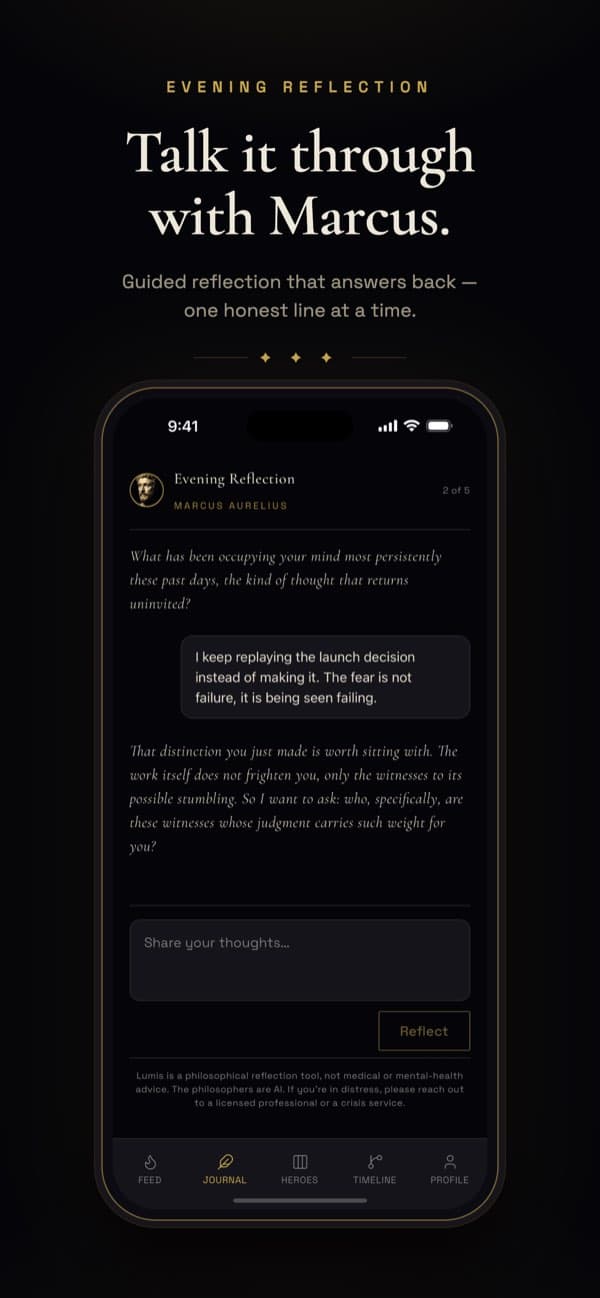
Counsel.
Your mentor reads the entry you wrote, not a template of it. He answers with a cited passage and one question back. He asks; you reason.
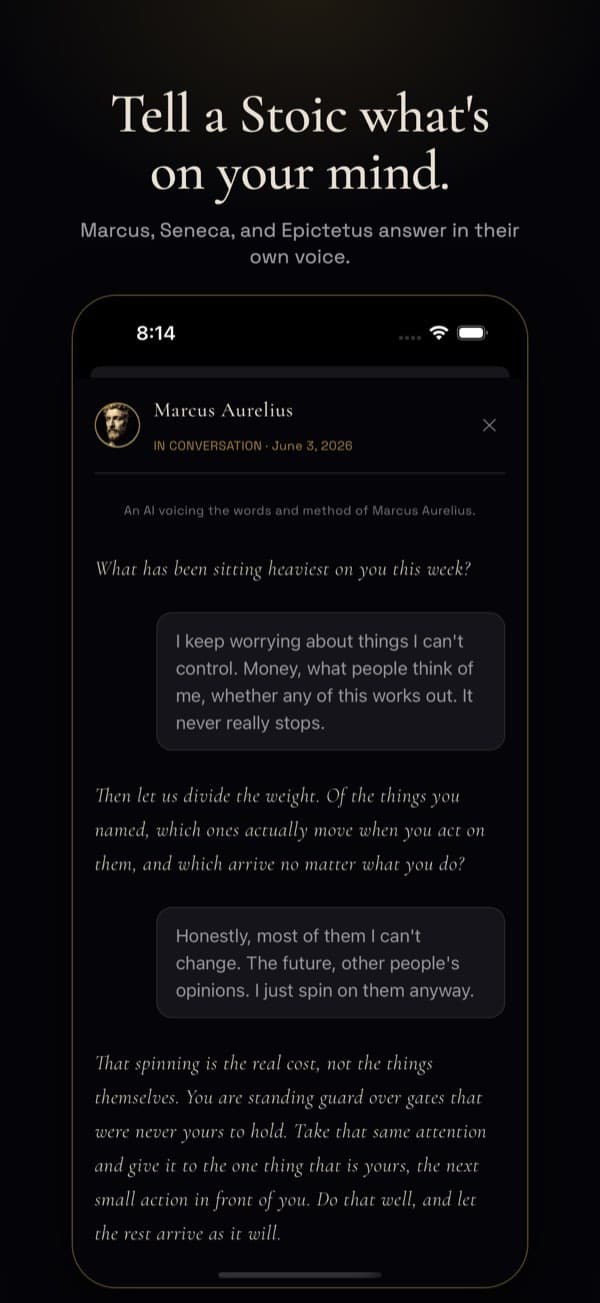
Act.
The entry ends with a decision, not a mood: one judgment examined, one thing named for tomorrow. That's the whole rep.
7-day free trial. $99.99/year after, only if you stay. Cancel anytime in your Apple subscription settings.
What the system holds.
Journal
Guided entries that open with a question. Never a blank page.
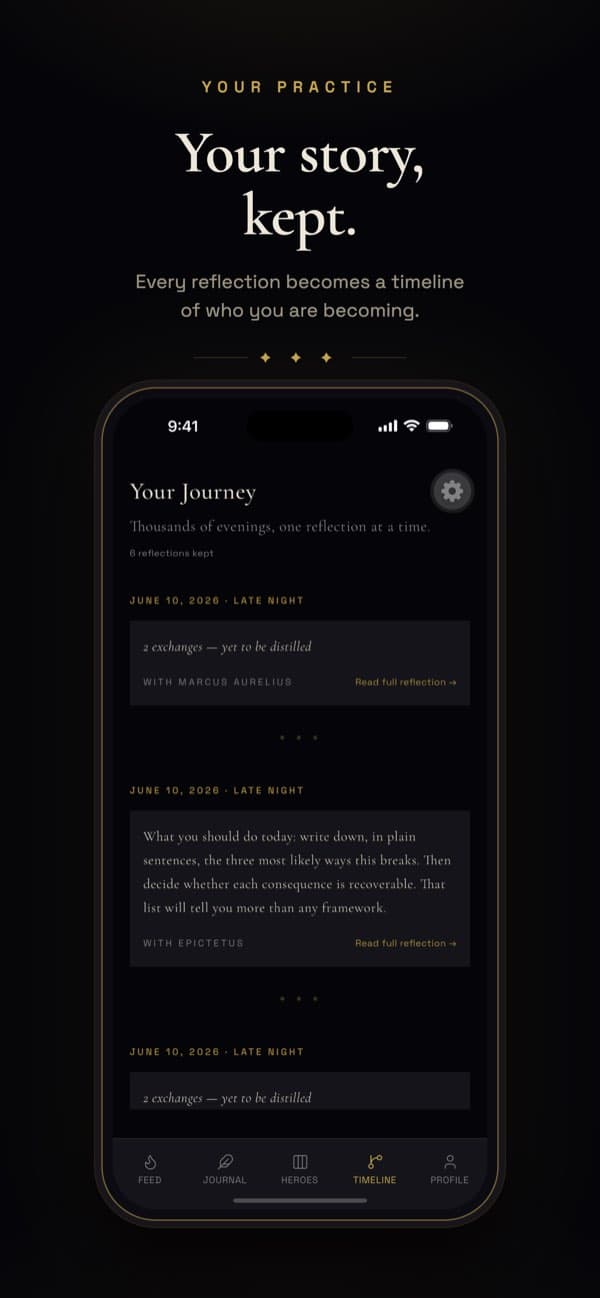
Timeline
Every entry filed and dated, accruing into a record you can stand behind. Your own Meditations, in your own words.
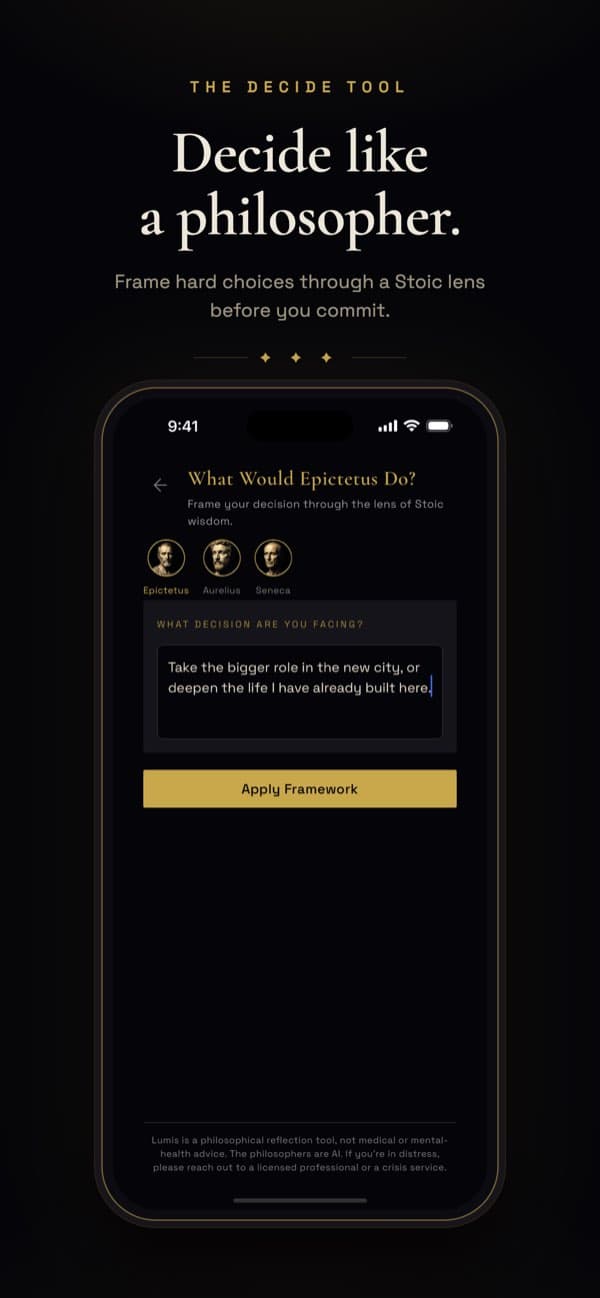
The Decide tool
For decisions that keep circling. Name the choice, weigh what's in your control, come out with a position you can defend to yourself.
The flame
The first thing Lumis does is light a candle. It grows as you answer, step by step, until it burns full.
Sixty days of entries is a different object than six. The Timeline makes that visible, one dated entry at a time.
What happens to the entries.
- 1.No mentor reads an entry until you grant consent in the app, and you revoke it in the app, any time.
- 2.Your entries never train AI. Not by us; and Anthropic's commercial API terms prohibit training on our data.
- 3.Deletion is yours, in the app. Account, entries, conversations: no email, no support ticket.
The full accounting is on the homepage and at /privacy. Same claims, same words. /privacy.
Questions worth asking first
Isn't journaling soft?
Marcus Aurelius wrote his from an army camp on the Danube. Seneca describes examining his entire day, deeds and words, concealing nothing. Whatever you call the practice of facing your own record without flinching, soft isn't it.
I already train. Where does this fit?
At the other end of the day. The debrief takes about five minutes and asks nothing physical: what happened, what you judged it to mean, what carries. The training log covers the body. This is the same honesty, pointed inward.
Do I need to know anything about Stoicism?
No. If you've never read a page of Marcus Aurelius, the mentors meet you where you are. If you've read all of it, every quotation is cited to book and section, so you can check us.
What does the AI actually do?
It doesn't write your journal, and it doesn't think for you. You write; the mentor responds to what you actually wrote, with counsel drawn from his own works, cited, and usually a question back. He asks; you reason. Everything AI-composed is labeled as AI.
What does it cost?
$9.99 a month or $99.99 a year, each after a 7-day free trial; or $199.99 once for lifetime access. What you see is what you’re billed.
Can I cancel anytime?
Yes. The subscription runs through Apple. Cancel in your Apple subscription settings anytime, including during the trial, and you won’t be billed.
How do I start?
Download it, light the candle, and take the 7-day free trial. The first entry takes about two minutes.
The body got built out of unremarkable days, kept. The mind is built the same way. One entry at the end of the day: what happened, what you judged it to mean, what carries into tomorrow. Written down, the day can be examined instead of replayed.
That's the debrief. The practice outlasted the empire.
The door is open.
7-day free trial. $99.99/year after, only if you stay. Cancel anytime in your Apple subscription settings.