Now on the App Store
For the mind that won't shut up.
Stoic journaling, with mentors who answer. Write the spiral down, and let Marcus, Seneca, or Epictetus answer tonight.
 7-day free trial. Cancel anytime.
Built on Meditations, Letters to Lucilius, the Discourses, the Enchiridion, and On Anger. Every quotation cited to book and section.
Counsel is AI-composed and labeled. The quotations are the philosophers' own. Conversations processed by Anthropic, under commercial terms that prohibit training on your words.
Some nights sound like this.
- Replaying today's conversations, word for word, again.
- I know I'm overthinking. Knowing doesn't stop it.
- Tired from a mind that won't clock out.
- Lights out is when the argument with myself starts.
None of these get argued with here. They get somewhere to go.
The spiral is old news.
There are more things, Lucilius, likely to frighten us than there are to crush us; we suffer more often in imagination than in reality.
Written 2,000 years before your 3am spiral.
Seneca described the loop, and left a practice for it: put the thought in writing, examine the judgment inside it, keep what survives.
What counsel looks like
In the app, the mentors answer what you actually wrote, in their own cited words, and end with a question back. It reads like this.
My mind keeps writing stories that end badly.
He suffers more than is necessary, who suffers before it is necessary.
I'm braced all day for things that never happen.
Do not disturb thyself by thinking of the whole of thy life. Let not thy thoughts at once embrace all the various troubles which thou mayest expect to befall thee: but on every occasion ask thyself, What is there in this which is intolerable and past bearing?
I lie down and the day starts replaying itself.
When the lamp is taken out of my sight, and my wife, who knows my habit, has ceased to talk, I pass the whole day in review before myself, and repeat all that I have said and done: I conceal nothing from myself, and omit nothing.
The rest of the answers live in the app.
Three mentors, for three kinds of thoughts.

Marcus Aurelius
For perspective.
An emperor who wrote to himself at night, for no audience. The voice for when everything feels too large.
Nowhere either with more quiet or more freedom from trouble does a man retire than into his own soul.
Meditations 4.3 · tr. George Long

Seneca
For the spiral.
A statesman who watched his own mind invent disasters, and said so in writing. The voice for the loop itself.
Beasts avoid the dangers which they see, and when they have escaped them are free from care; but we men torment ourselves over that which is to come as well as over that which is past.
Letters to Lucilius 5.9 · tr. Richard Mott Gummere

Epictetus
For what you control.
Born a slave, exiled, unbothered. He drew the line between what is yours and what never was. The voice for when you're gripping things that were never in your hands.
Some things are in our control and others not.
Enchiridion 1.1 · tr. Elizabeth Carter
No true likeness of these men survives. Our portraits are imagined, made by human direction and human hands.
What happens at 11:47pm
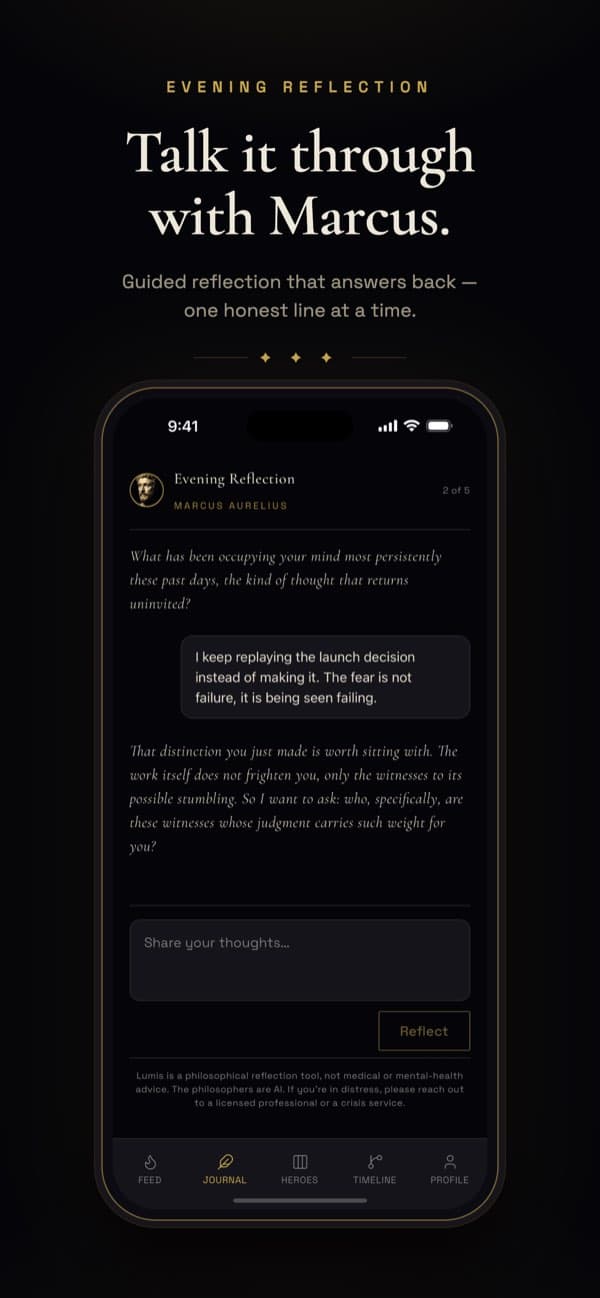
Write.
A question is already waiting, in the lineage of the evening review the Stoics kept: Where went I wrong? Did what? And what to be done was left undone? (The Pythagorean verses Epictetus taught his students. Discourses, 3.10.) You write what's actually there.
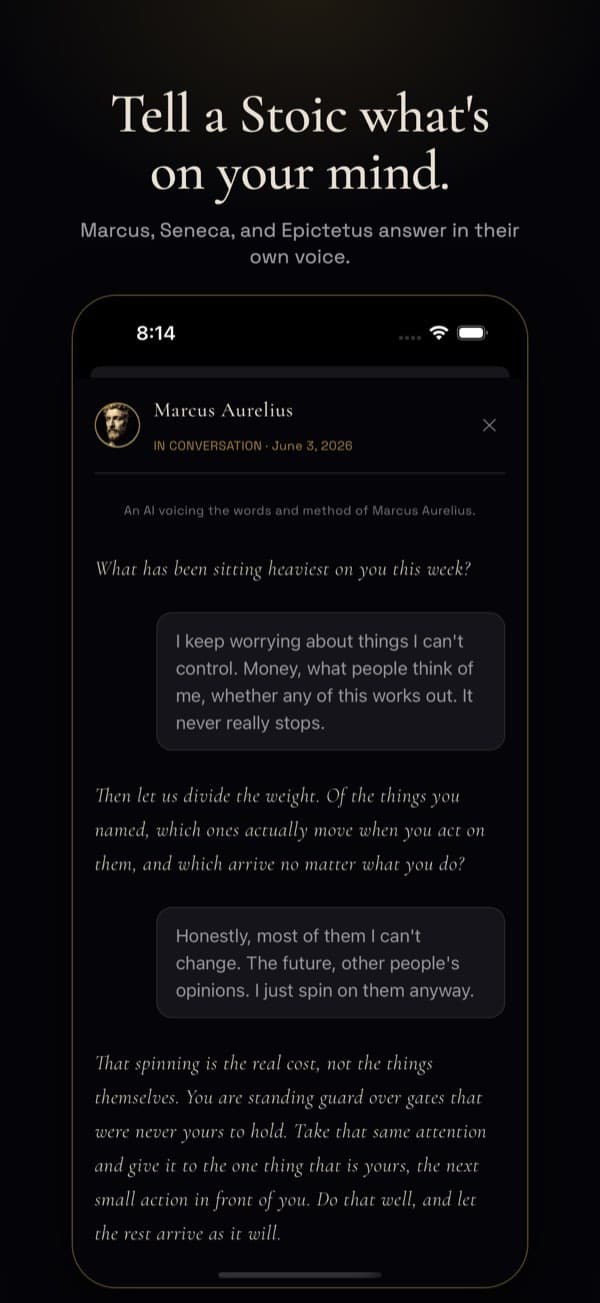
Counsel.
Your mentor reads what you wrote, not a template of it. He answers with a cited passage and a question back. He asks; you reason.
Act.
The entry ends where tomorrow starts: a judgment examined, a practice named, one thing worth carrying out of the page.
7-day free trial. Cancel anytime.Every room, one practice.
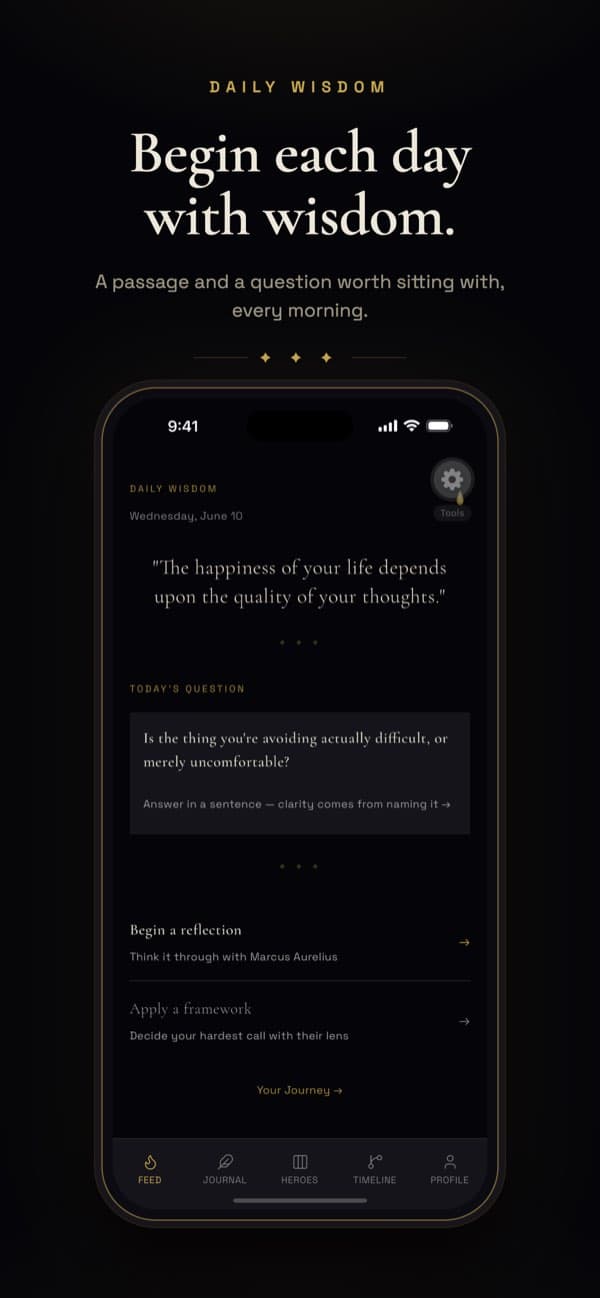
Feed
One cited passage waiting when you open the app, with a line on why it was chosen.
Journal
Guided entries that start with a question. Never a blank page.
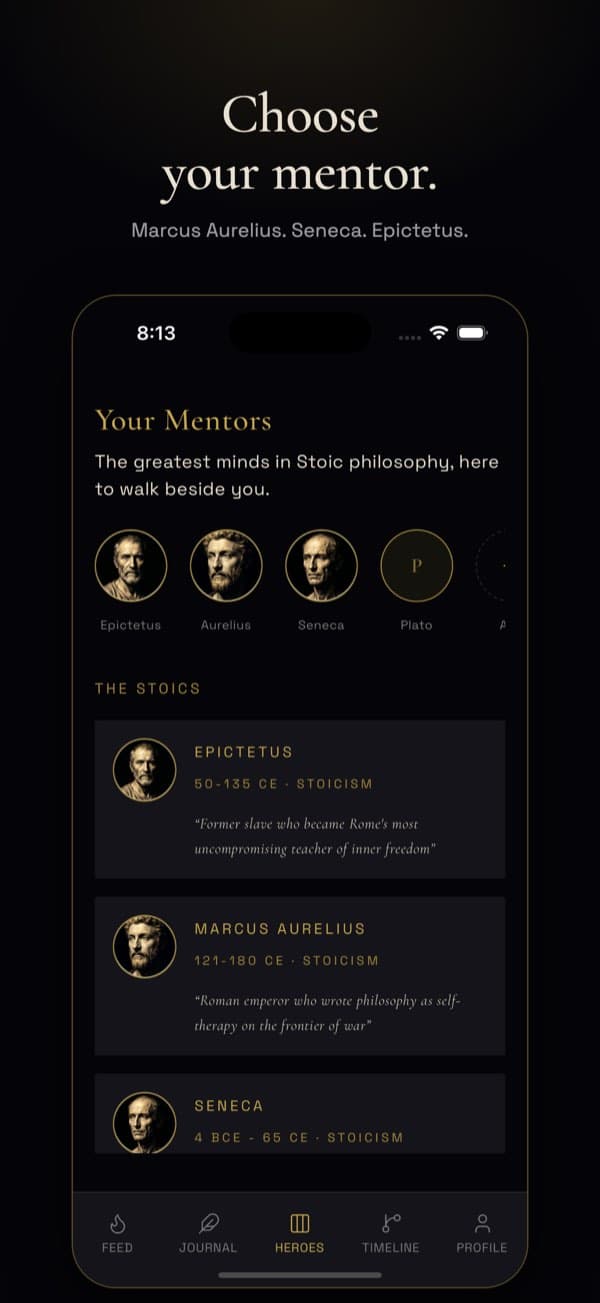
Heroes
The mentors. Read them, then write to them. They answer what you actually wrote.
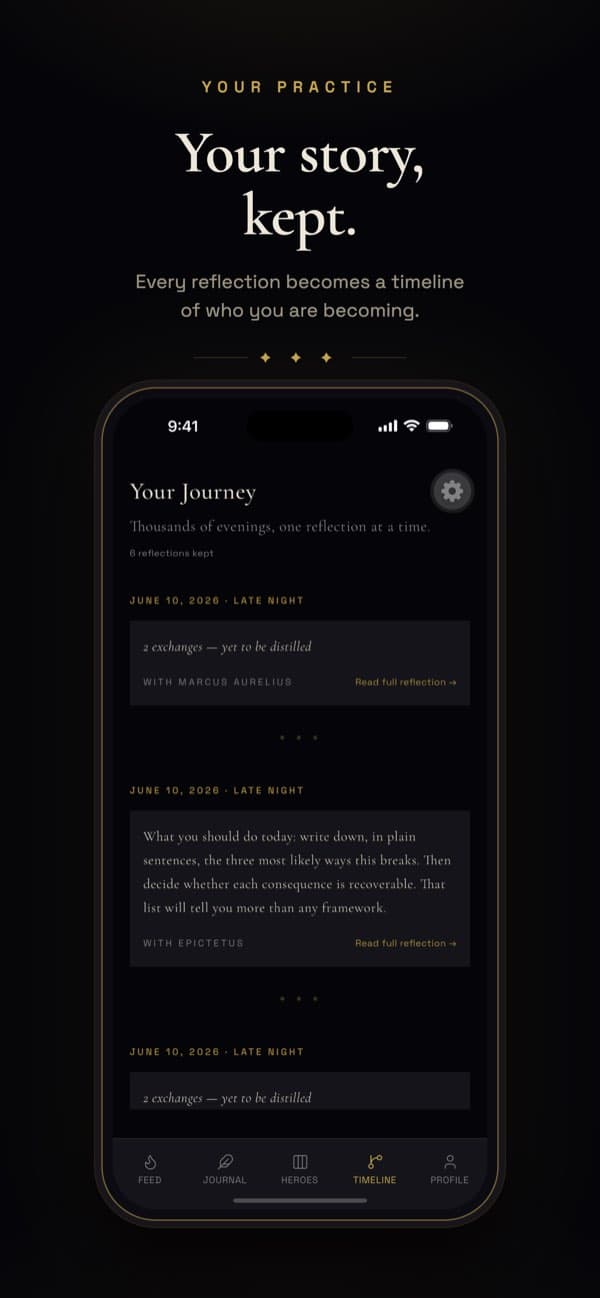
Timeline
Your entries, accruing into something you can look back through. Your own Meditations, in your own words.
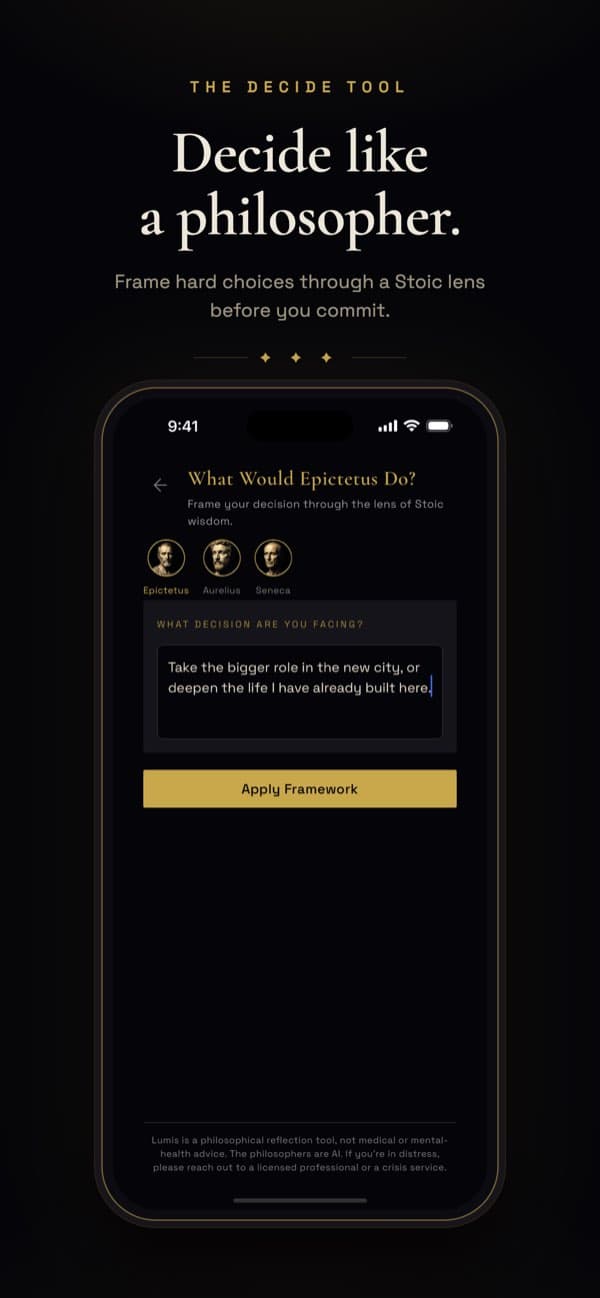
The Decide tool
For decisions that keep circling. Name the choice, weigh what's in your control, come out with a position you can defend to yourself.
Profile
Your practice, your consent switches, and the flame you keep.
The first thing Lumis does is light a candle. It grows as you answer, step by step, until it burns full.
Choose the door. The room behind it is the same.
Monthly
Seven days free, then the practice, month to month. Cancel anytime.
Annual
7-day free trial
A year settles it once, and costs less than paying by the month.
Seven days free, then a full year of the practice.
Lifetime
Pay once. The practice is yours for good.
Every plan opens the same practice. Start with the 7-day trial.What you see is what you're billed. Prices set in App Store Connect; your subscription is managed in your Apple account.
What happens to what you write at 2am
- 1.Nothing is read by a mentor until you say so. Mentor access to your entries is a consent you grant in the app, and revoke in the app, any time. Revoked means they stop reading.
- 2.Your entries never train AI. Not by us; and Anthropic's commercial API terms prohibit training on our data.
- 3.The counsel is generated by Anthropic's Claude, and it is labeled as AI wherever it speaks.
- 4.Your mentor remembers your thread, so counsel can follow what you've been working through. Your recent conversations are sent to Anthropic as context when a mentor answers, under the same no-training terms.
- 5.Deletion is yours, in the app. Account, entries, conversations: deleted from inside the app, no email, no support ticket.
This page keeps its own ledger honest too. We use PostHog analytics to see which sections earn attention. Ask Marcus questions are processed by Anthropic to answer you, and are never stored.
The long version is at /privacy. It says the same things.
Questions worth asking first
Is this therapy?
No. Lumis is a practice, not treatment. Stoic journaling is a way to examine your own judgments; it is not a substitute for a therapist, and it sits comfortably alongside one. If you're in crisis, reach a professional first.
Do I need to know anything about Stoicism?
No. If you've never read a page of Marcus Aurelius, the mentors meet you where you are. If you've read all of it, every quotation is cited to book and section, so you can check us.
Who reads what I write?
By default, no mentor reads anything. Mentor access is a consent you grant in the app and can revoke in the app. When a mentor answers, your words are processed by Anthropic to generate the response, under commercial terms that prohibit training on them. You can delete your account and every entry from inside the app.
What does the AI actually do?
It doesn't write your journal, and it doesn't think for you. You write; the mentor responds to what you actually wrote, with counsel drawn from his own works, cited, and usually a question back. He asks; you reason. Everything AI-composed is labeled as AI.
What does it cost?
$9.99 a month or $99.99 a year, each after a 7-day free trial; or $199.99 once for lifetime access. What you see is what you’re billed.
Can I cancel anytime?
Yes. The subscription runs through Apple. Cancel in your Apple subscription settings anytime, including during the trial, and you won’t be billed.
How do I start?
Download it, light the candle, and take the 7-day free trial. The first entry takes about two minutes.
Lumis won't promise you a quiet mind. The Stoics never had one either; they had a practice for meeting it. Written down, a thought can be examined instead of obeyed. Judged for what it is. Kept, or dismissed on purpose.
That's the whole practice. It takes about as long as one replay.
The door is open.
7-day free trial. Cancel anytime.