Marcus Aurelius wrote Meditations for himself. Write yours with him.
Stoic journaling, with the mentors present. You write; Marcus, Seneca, and Epictetus answer with cited passages and a question back.
Asked here earlier:
I have read Meditations twice, but when someone cuts me off or a day goes wrong, all of it disappears and I react like I never read a word. How do I make the practice hold under pressure?
You have named the common gap between knowing and becoming. Reading twice changes your mind; pressure reveals what truly dwells there. Do not despair—this is your work beginning, not failing.
Reframe thus: the moment of irritation is not your enemy but your teacher. You do not lose what you have learned; you discover what remains unlearned. The cuts and wrongs are precisely where philosophy must live, not in the quiet study.
One practice: when tension rises, pause and name one thing not in your control—the other's rudeness, the day's outcome. Say it plainly. Then name what remains yours—your response, your breath, your judgment. Do this small thing repeatedly, even awkwardly, until it becomes reflex.
The knowledge does not disappear. You simply must forge it into habit through the very trials that test you.
What small, unavoidable frustration will you meet today as your practice ground?
Don't take the page's word for it. Test him against the texts.
Free to ask. No account.
Built on Meditations, Letters to Lucilius, the Discourses, the Enchiridion, and On Anger. Every quotation cited to book and section.

7-day free trial. $99.99/year after, only if you stay. Cancel anytime in your Apple subscription settings.
Built on Meditations, Letters to Lucilius, the Discourses, the Enchiridion, and On Anger.
Every quotation cited to book, section, and translator, on this page and in the app.
Translations named: Hays, Long, Gummere, Carter, Hard, Stewart.
Counsel is AI-composed and labeled. The quotations are the philosophers' own.
If you practice, some of these are yours.
- I've read Meditations twice. It doesn't survive a bad morning.
- My Stoicism lives in the highlights, not the day.
- I keep the theory. I lose the practice.
- Every Stoicism feed I followed turned into a storefront.
The first three are the oldest problem in the school: the reading is easy to keep and hard to use. The Stoics built a practice for exactly that, and it is the next section down.
The fourth one is about pages like this, and it is fair. So instead of persuasion, here is what you can check: the price is one number, stated plainly, in the FAQ. The demo above is open, with no account. And every quotation on this page carries its book, section, and translator, so you can hold it against your own copy.
The practice that survives stress was never the reading. It was the review.
Where went I wrong? Did what? And what to be done was left undone?
The Golden Verses of Pythagoras. Epictetus did not invent these questions; he set his students to keep them at hand. The lineage is older than the school.
And the review was kept, not shelved. Seneca, describing his own:
When the lamp is taken out of my sight, and my wife, who knows my habit, has ceased to talk, I pass the whole day in review before myself, and repeat all that I have said and done: I conceal nothing from myself, and omit nothing.
This is the lineage Lumis takes up. The review, guided. The counsel, cited. The reasoning, yours.
The mentors, from their own pages.
Lumis draws its counsel from the texts, not from content about the texts. Each mentor answers in his own cited words, and ends with a question back to you.

Imagined portrait, human-directed.
Marcus Aurelius
For perspective.
He wrote Meditations in Greek, in an army camp, addressed to no one but himself. It was never meant for publication. That is the register Lumis renders him in: private, exact, unimpressed by excuses.
Such as are thy habitual thoughts, such also will be the character of thy mind; for the soul is dyed by the thoughts.
Meditations 5.16 · tr. George Long

Imagined portrait, human-directed.
Seneca
For the spiral.
The Letters to Lucilius are moral practice conducted by correspondence: one man teaching another to examine his own judgments, in writing, over years.
He suffers more than is necessary, who suffers before it is necessary.
Letters to Lucilius 98.8 · tr. Richard Mott Gummere

Imagined portrait, human-directed.
Epictetus
For what you control.
Born a slave, exiled by an emperor. He wrote nothing down; his student Arrian kept the Discourses, and the Enchiridion is their field manual. The hardest lines in the school are his.
Some things are in our control and others not.
Enchiridion 1.1 · tr. Elizabeth Carter
No true likeness of these men survives. Our portraits are imagined, made by human direction and human hands.
The review, guided.
Write.
The evening entry opens on the old questions: Where did I go wrong? What did I do? What duty was left undone? (The Pythagorean verses Epictetus taught. Discourses, 3.10.) You answer them about the actual day, in your own hand.
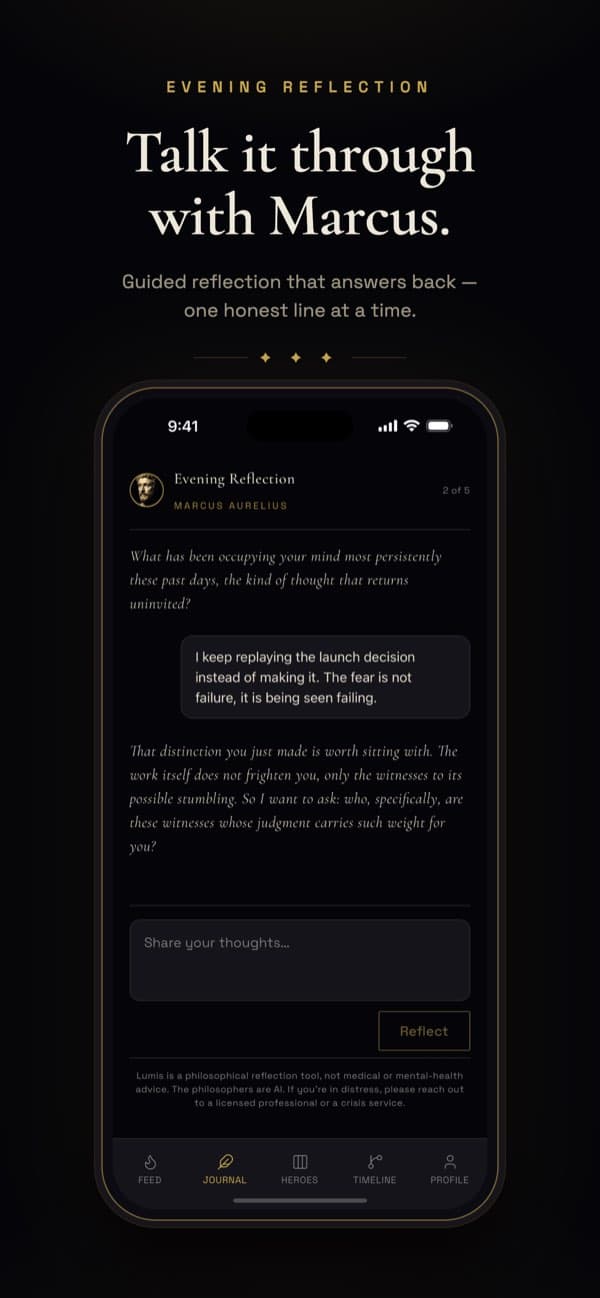
Counsel.
Your mentor reads what you wrote, not a template of it. He answers with a cited passage, book and section engraved beneath it, and a question back. He asks; you reason.
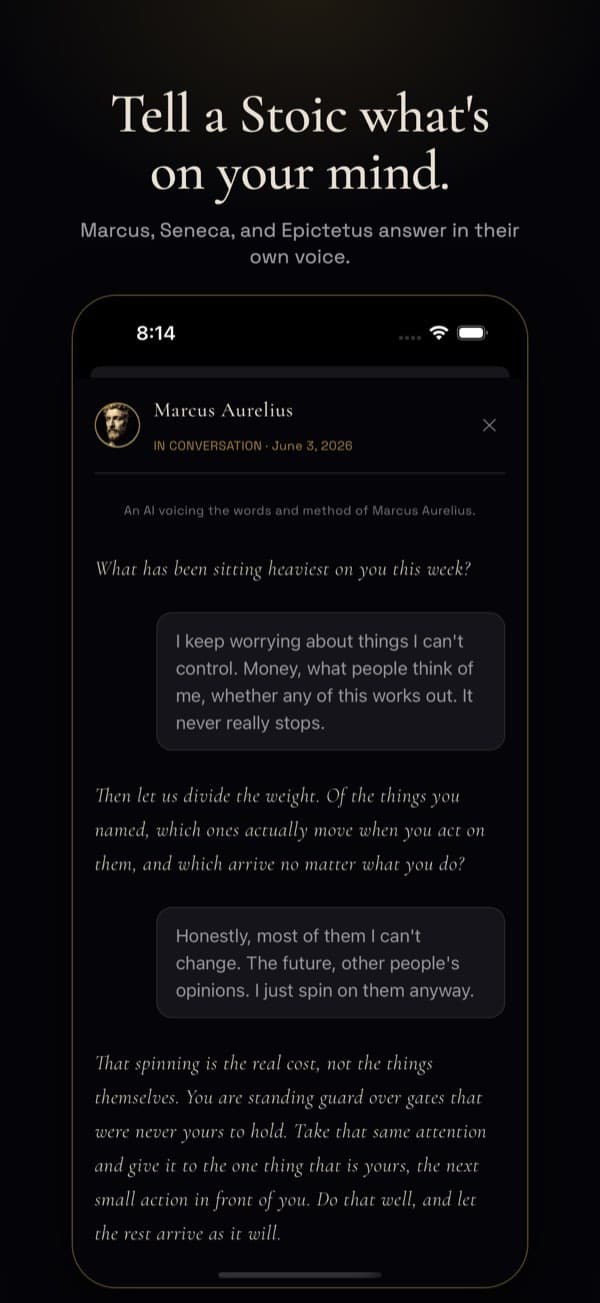
Act.
The entry closes the way the review was meant to close: a judgment examined, a fault named without cruelty, one correction carried into tomorrow.
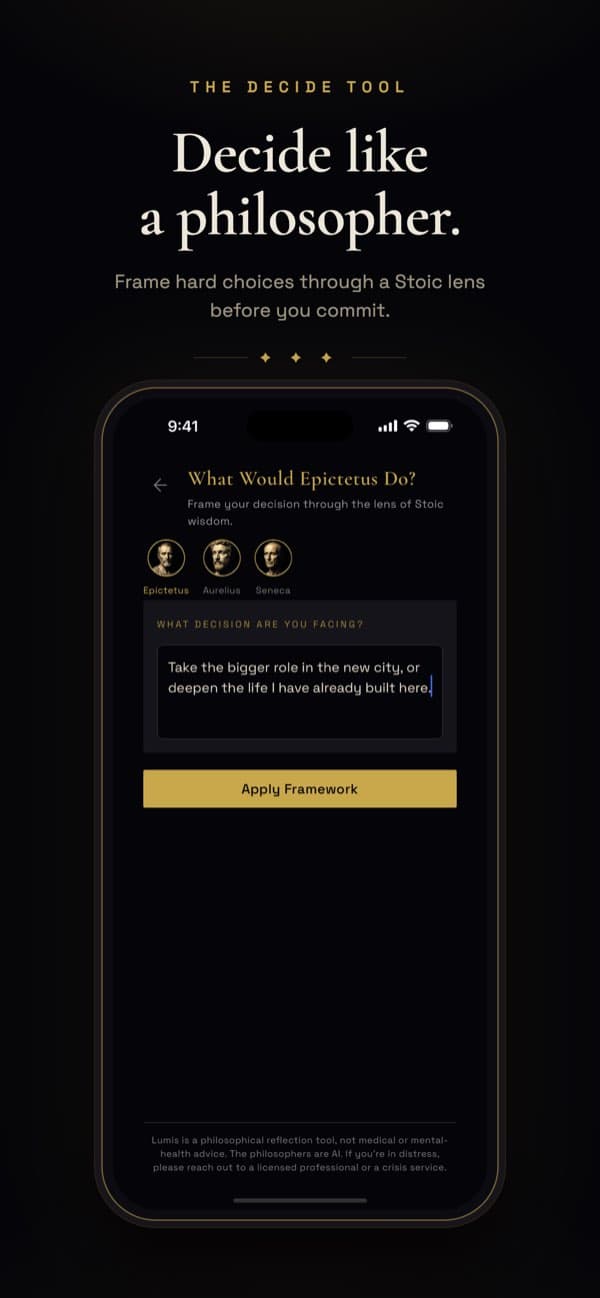
7-day free trial. $99.99/year after, only if you stay. Cancel anytime in your Apple subscription settings.
Inside the app.
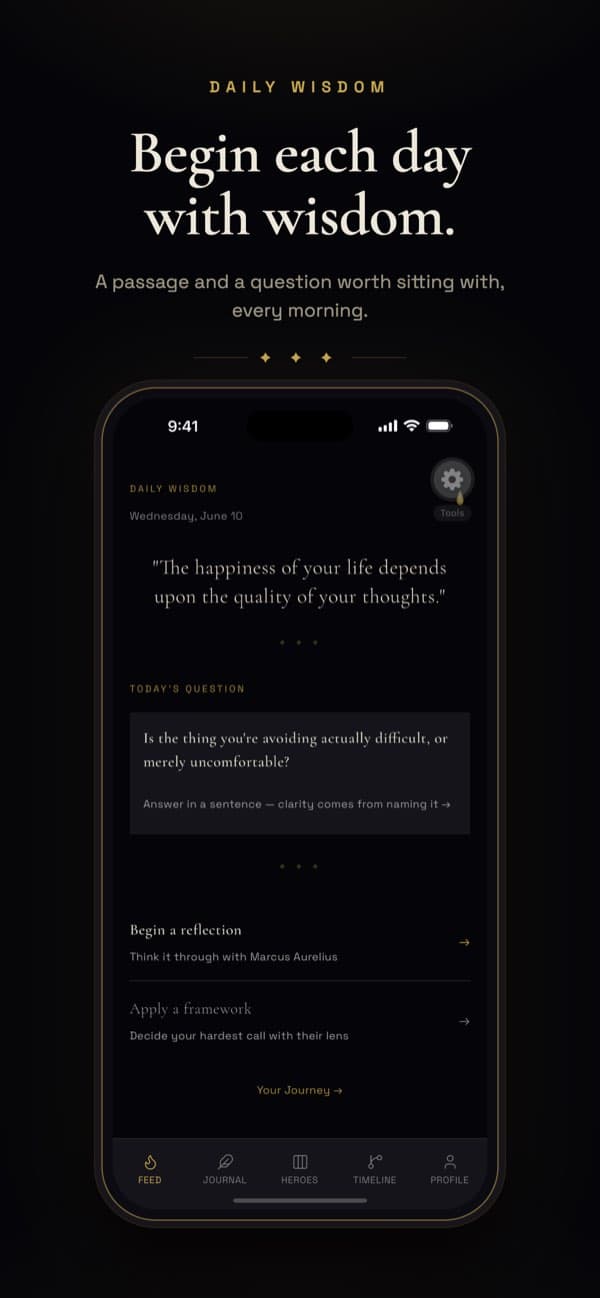
Feed
One cited passage waiting when you open the app, with a line on why it was chosen.
Journal
Guided entries that start with a question. Never a blank page.
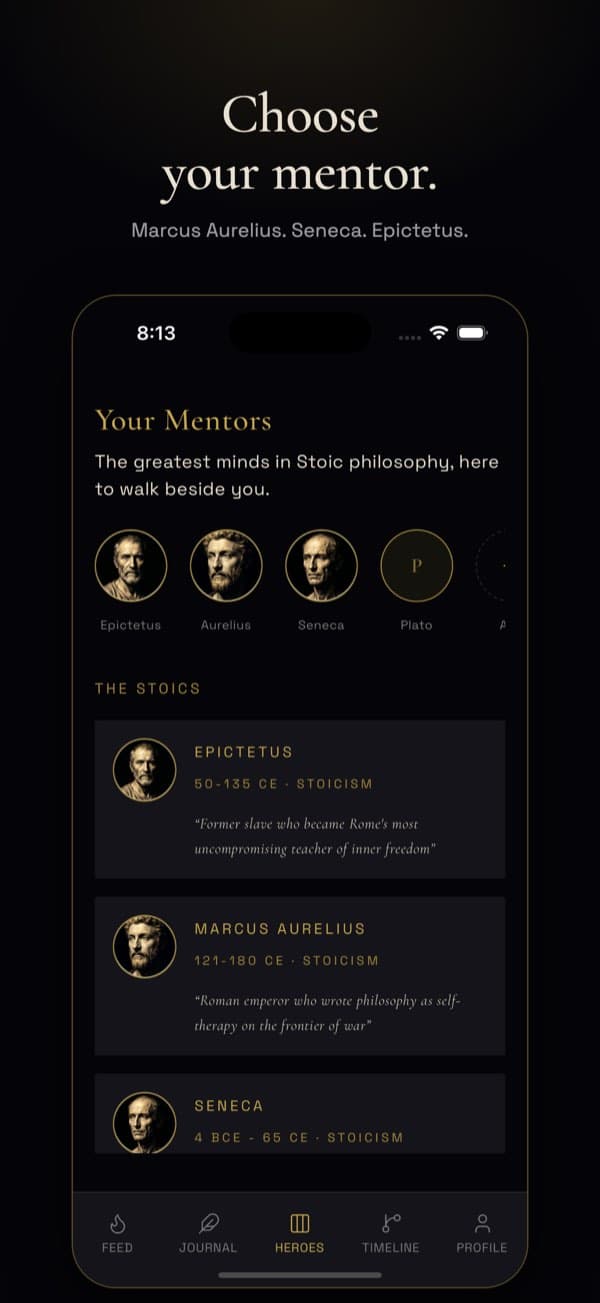
Heroes
The mentors. Read them, then write to them. They answer what you actually wrote.
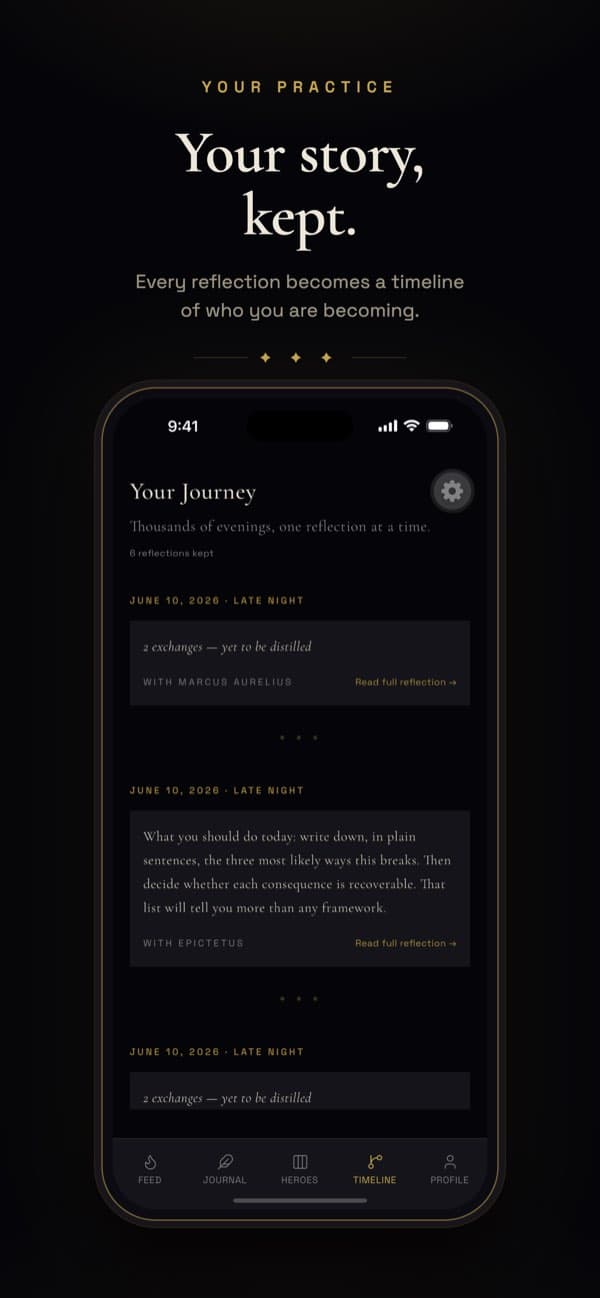
Timeline
Your entries, accruing into something you can look back through. Your own Meditations, in your own words.
What happens to what you write
- 1.Nothing is read by a mentor until you say so. Mentor access is a consent you grant in the app, and revoke in the app, any time.
- 2.Your entries never train AI. Not by us; and Anthropic's commercial API terms prohibit training on our data.
- 3.Deletion is yours, in the app. Account, entries, conversations: deleted from inside the app, no email, no support ticket.
The full accounting is on the home page and at /privacy. They say the same things. /privacy.
Questions worth asking first
Is this another funnel wrapped around Stoic language?
You've seen that done, and this page is written knowing it. So, plainly: the price is one number, in Q5 below. The demo at the top asks for no account. Every quotation here is cited to book, section, and translator, and the source texts are named. Check any of it against your own shelf. If Lumis earns a place in your practice, it should be because the practice holds, not because a page talked you into it.
Are the quotations real?
Every quotation on this site and in the app is drawn from a single sourced registry, cited to book, section, and translator, and checked against a published translation. The famous line about having power over your mind that gets attributed to Marcus everywhere? It isn't in Meditations, and it isn't in Lumis. The counsel around the quotations is AI-composed, and it is labeled as AI wherever it speaks.
What does the AI actually do?
It doesn't write your journal, and it doesn't think for you. You write; the mentor responds to what you actually wrote, with counsel drawn from his own works, cited, and usually a question back. He asks; you reason. Everything AI-composed is labeled as AI.
I already keep a morning reading and an evening journal. Why an app?
Keep them. Lumis doesn't replace the texts or the notebook; it is the evening review with an interlocutor in it: counsel that responds to what you actually wrote, cites its source, and asks the next question. The hard part of the practice was never the reading. It's the hour after something goes wrong. That hour is what the guided review is for.
What does it cost?
$9.99 a month or $99.99 a year, each after a 7-day free trial; or $199.99 once for lifetime access. What you see is what you’re billed.
Can I cancel anytime?
Yes. The subscription runs through Apple. Cancel in your Apple subscription settings anytime, including during the trial, and you won’t be billed.
How do I start?
Download it, light the candle, and take the 7-day free trial. The first entry takes about two minutes.
Meditations was not written for an audience. It was one man at the end of the day, holding his own judgments up to the light and writing down what he found. Nothing about that practice required an empire. It required the questions, the honesty, and the return to the page.
The practice is intact. Lumis keeps the room lit for it.
The door is open.
7-day free trial. $99.99/year after, only if you stay. Cancel anytime in your Apple subscription settings.